Blog Details
26Aug
Horseback Riding in Mustang, Nepal: The Ultimate Guide to Exploring the Last Forbidden Kingdom
Mustang is one of those places in Nepal where the journey feels inseparable from the landscape.
Far beyond the green hills and subtropical valleys most visitors associate with Nepal, Mustang unfolds as a world of wind-carved cliffs, barren plateaus, ancient villages, Buddhist monasteries, centuries-old trade routes, and high mountain passes. Here, the landscape changes dramatically from one valley to the next, and so do the communities, traditions, architecture, and ways of life.
For generations, horses have been part of this story.
Long before roads connected Mustang's villages, horses carried people and goods across the mountains. Traders travelled between Nepal and Tibet with salt, grain, wool, livestock, and everyday necessities. Families relied on horses to move between settlements, transport agricultural products, and cross terrain that was impossible to navigate by vehicle.
Today, horses remain an important part of Mustang's identity, even as roads, vehicles, migration, and tourism reshape the region.
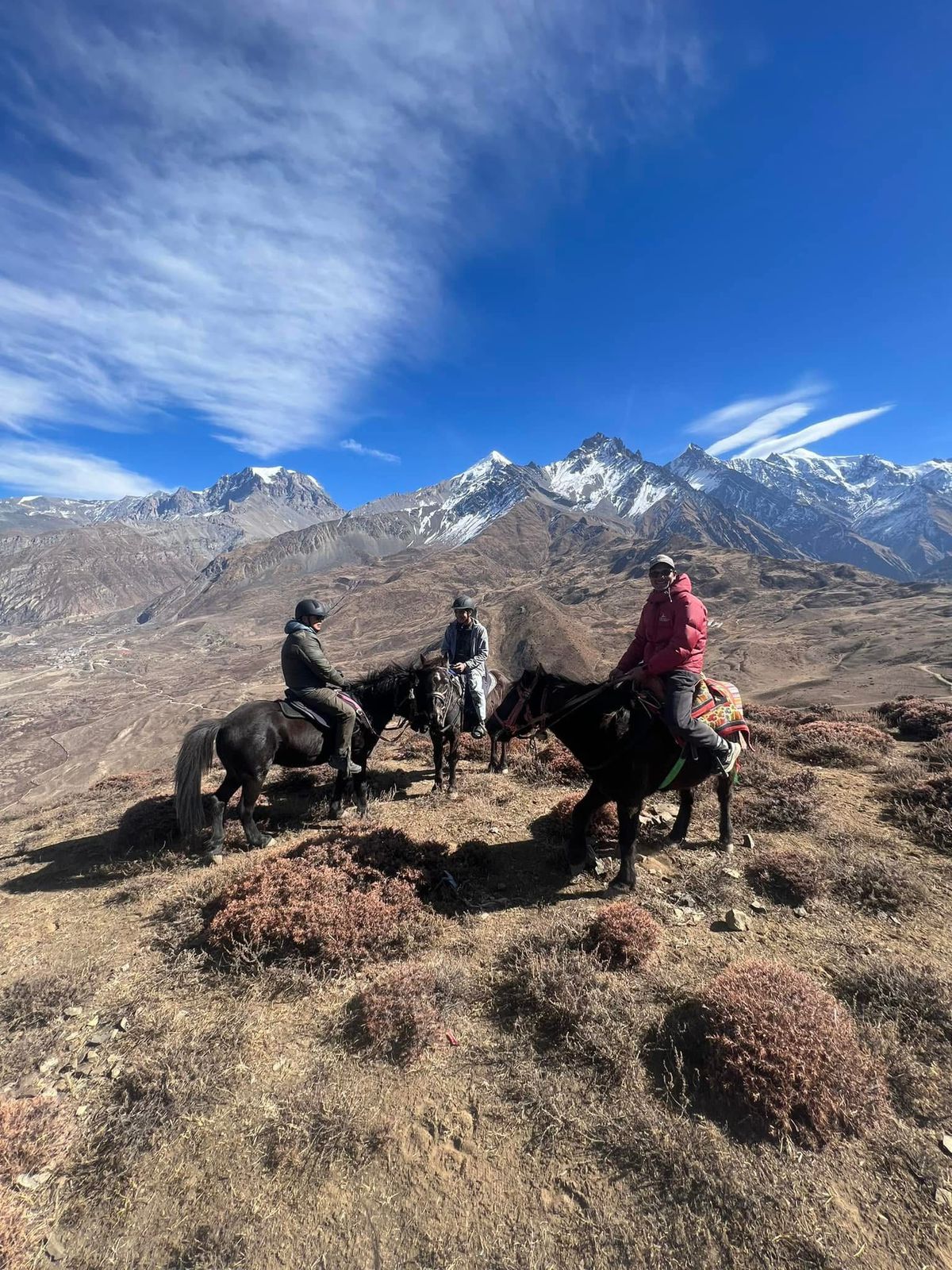
For travellers, exploring Mustang on horseback offers something different from simply visiting its famous viewpoints and monasteries. It allows you to travel through the landscape using an animal that has been part of Himalayan life for generations.
But Mustang is not one single cultural landscape.
The region broadly divides into Lower Mustang and Upper Mustang, and understanding the difference between them is essential to understanding Mustang itself.
Lower Mustang and Upper Mustang: Two Different Sides of Mustang
Although Lower and Upper Mustang belong to the same Himalayan region, they offer noticeably different experiences.
Lower Mustang generally refers to the southern and central parts of the district, including places such as Jomsom, Marpha, Tukuche, Kagbeni, Muktinath, Jhong, Lubra, and surrounding valleys.
The landscape here is dramatic but relatively more accessible. The Kali Gandaki River cuts through the region, creating one of the world's deepest gorges, while orchards, agricultural terraces, villages, monasteries, and mountain trails appear between the barren slopes.
As you travel north, the landscape becomes increasingly dry and stark.
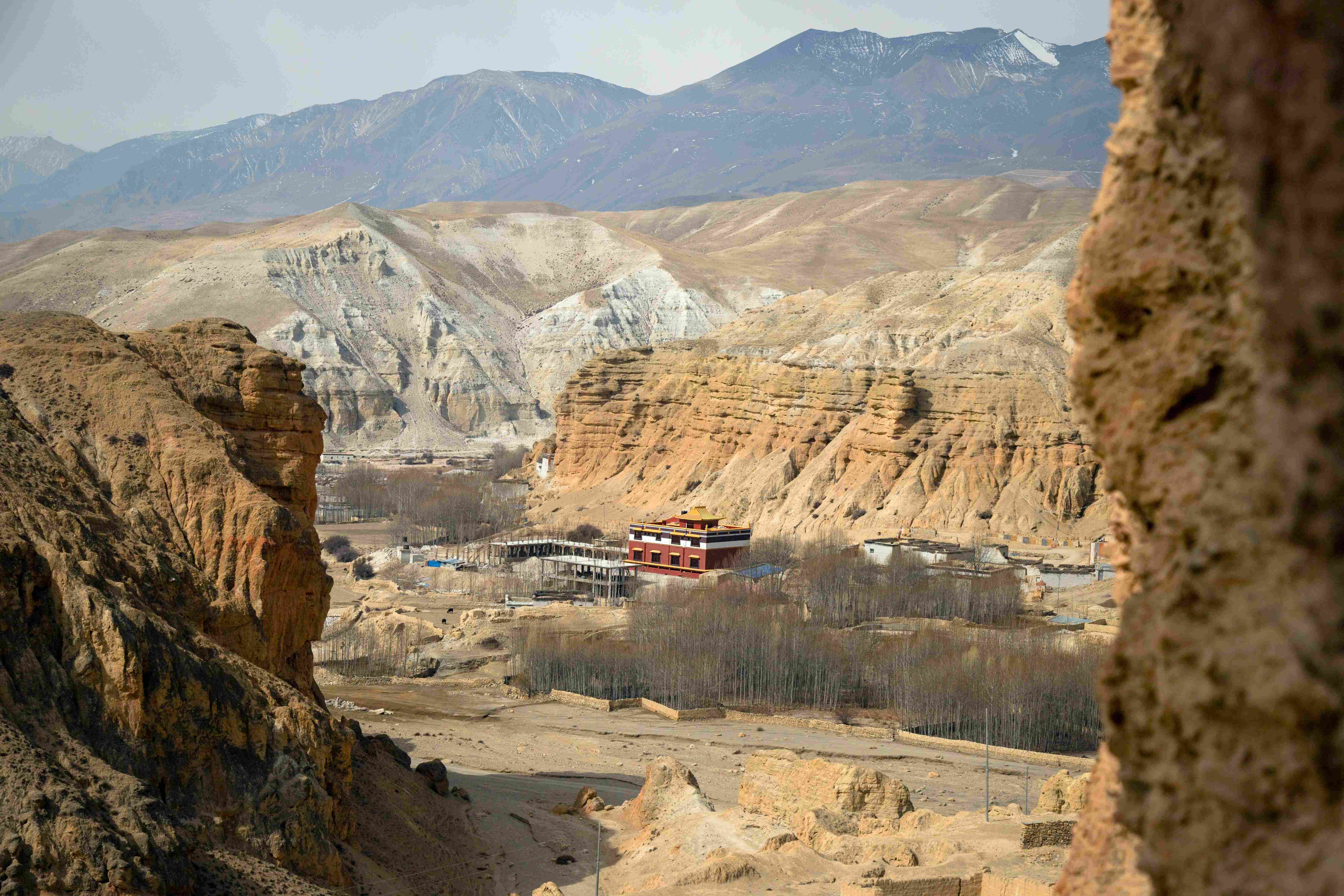
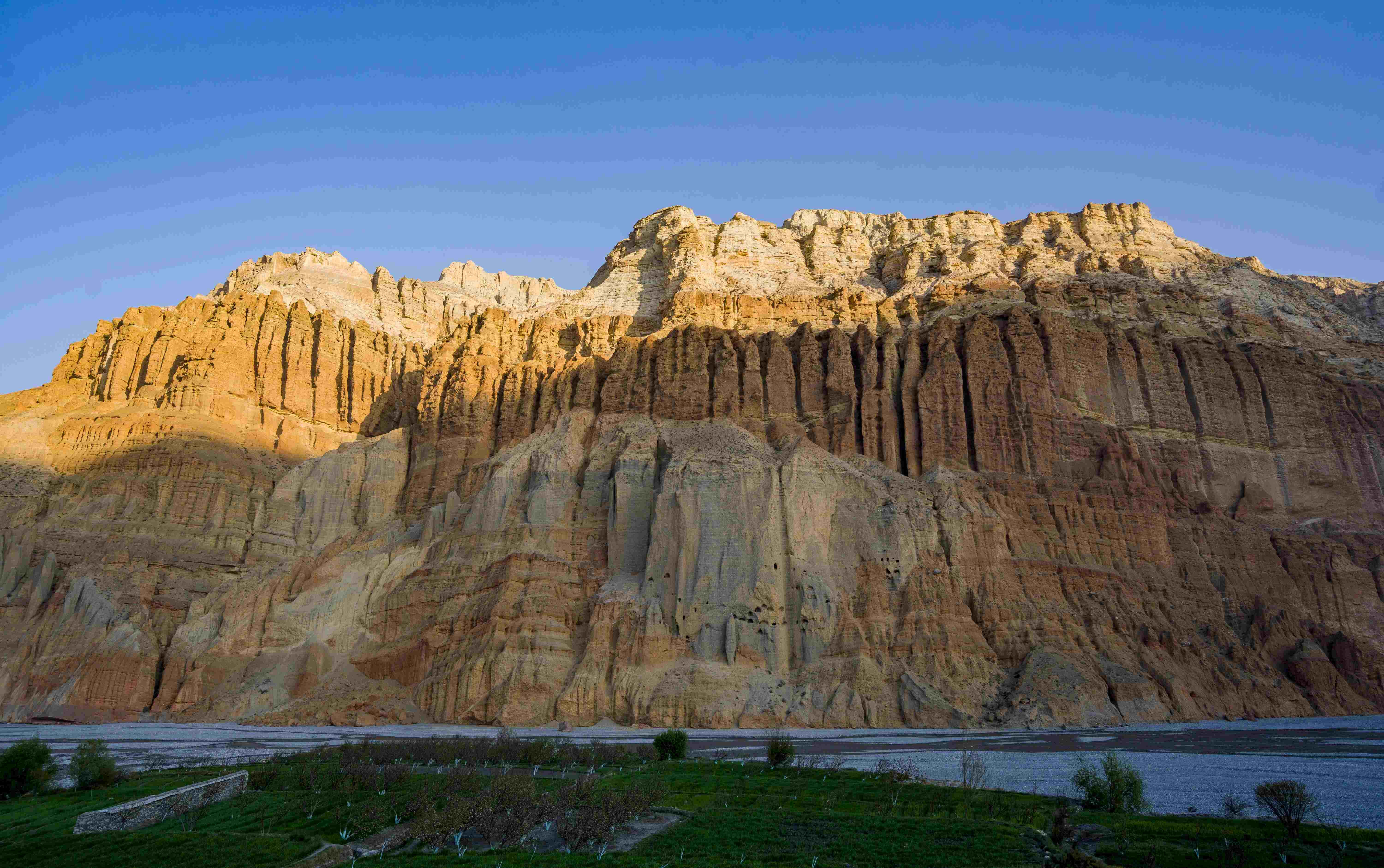
Upper Mustang lies beyond Kagbeni and extends towards the historic walled city of Lo Manthang and the northern frontier with Tibet. Here, the Trans-Himalayan environment becomes even more pronounced: vast barren valleys, eroded cliffs, ochre and red rock formations, caves carved into cliffs, fortified settlements, and ancient monasteries create a landscape unlike almost anywhere else in Nepal.
The cultural distinction is just as fascinating.
Lower Mustang represents a meeting point between several Himalayan and Nepalese traditions, with Thakali, Gurung, Magar, Tibetan Buddhist, Hindu, and Bon influences visible across different communities.
Upper Mustang, particularly the traditional region of Lo, retains a much stronger Tibetan cultural character. Tibetan Buddhism, traditional architecture, ancient monasteries, local festivals, and centuries-old customs remain deeply embedded in community life.
This is one reason Mustang is so rewarding for slow travel.
You are not simply moving through different landscapes. You are moving through different cultural worlds.
Why Is Upper Mustang Restricted?
Upper Mustang was opened to foreign travellers only in the early 1990s and remains a restricted area.
The restriction is connected to the region's proximity to the Tibetan border and its historical and geopolitical significance. It has also helped regulate tourism in an area with a particularly sensitive cultural and environmental landscape.
Travellers entering the restricted area require a Restricted Area Permit (RAP), in addition to the permits required for the conservation area.
This makes Upper Mustang more expensive and more regulated than Lower Mustang.
The restrictions have also contributed to limiting uncontrolled tourism and helped protect aspects of the region's cultural landscape. Ancient monasteries, traditional mud-brick architecture, centuries-old settlements, and religious practices remain prominent throughout the region.
That does not mean Upper Mustang is frozen in time.
It is not.
Roads have reached many settlements. Young people increasingly leave villages for education and employment. Modern construction materials and technologies are becoming more common. Tourism has become an important source of income.
Yet many of the region's traditions remain remarkably resilient.
Lower Mustang: More Accessible, but No Less Fascinating
For travellers who do not want to enter the restricted area, Lower Mustang offers an extraordinary alternative.
Places such as Jomsom, Marpha, Kagbeni, Muktinath, Jhong, and Lubra offer access to many of the cultural and geographical characteristics that make Mustang special.
Jomsom sits along the Kali Gandaki corridor and functions as an important administrative and commercial centre.
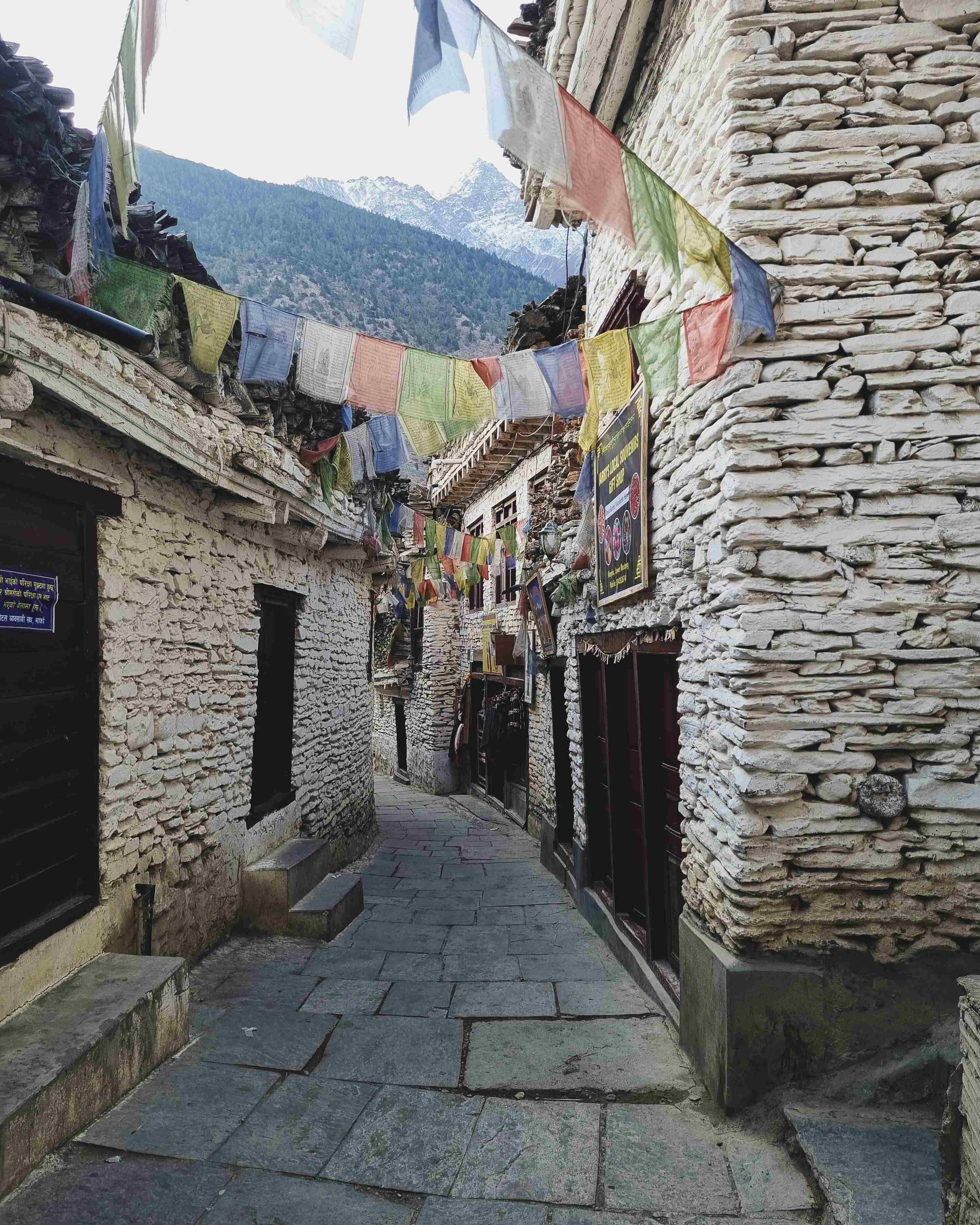
Marpha is known for its stone-paved lanes, whitewashed houses, monasteries, and apple orchards.
Muktinath is one of the Himalayas' most important pilgrimage destinations, sacred to both Hindus and Buddhists.
Jhong offers traditional architecture and a quieter village atmosphere.
And Lubra provides an opportunity to encounter one of Mustang's most distinctive surviving traditions: Bon, an ancient spiritual tradition that predates the widespread establishment of Tibetan Buddhism in the region.
Lower Mustang therefore should not be considered simply a "lesser" version of Upper Mustang.
It has its own character.
Its greater accessibility also makes it possible to experience Mustang through shorter journeys and different forms of travel, including trekking, jeep journeys, cycling, and horseback expeditions.
The Horses of Mustang
To understand horseback travel in Mustang, it helps to understand the animals themselves.
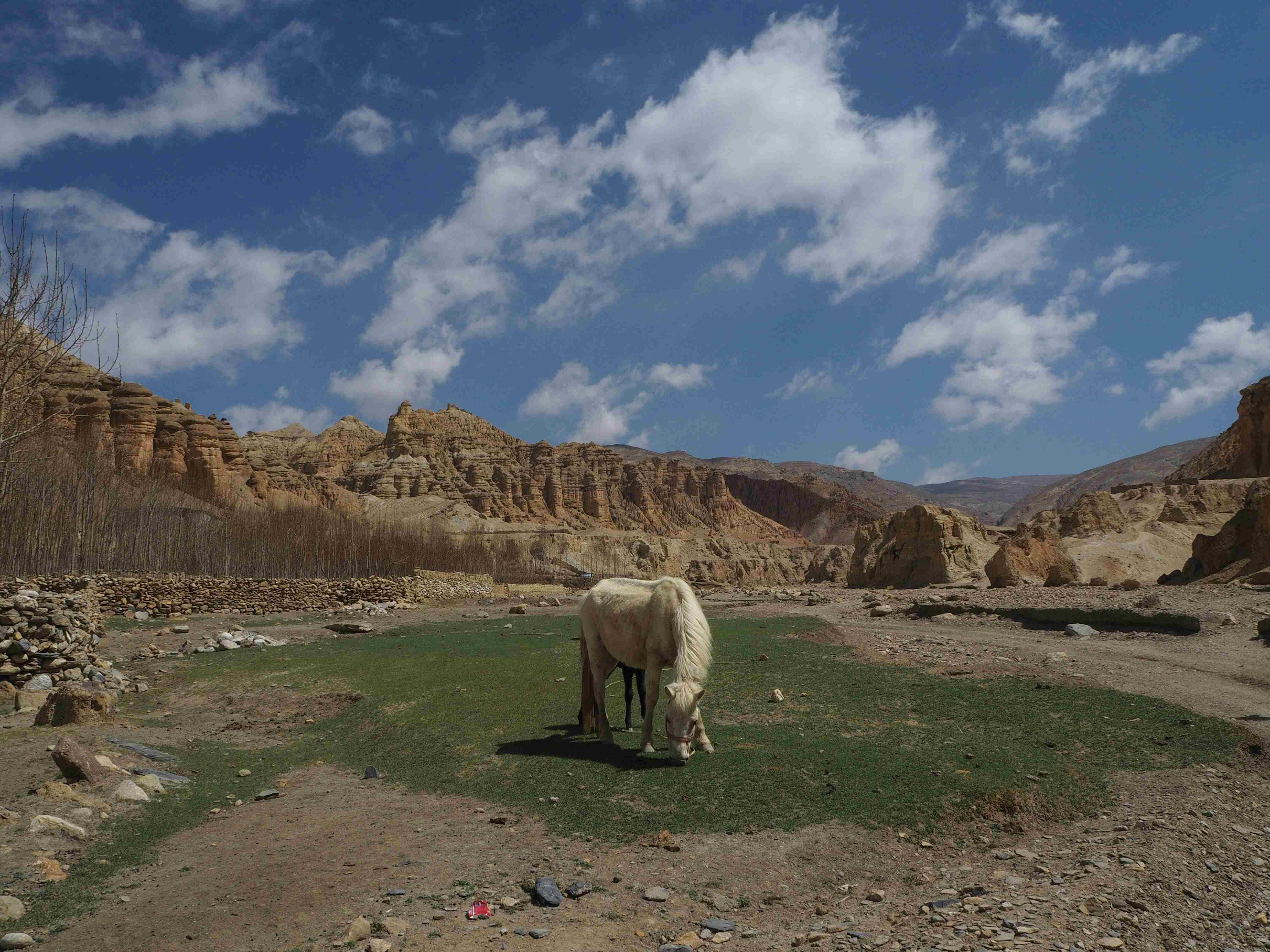
The horses traditionally used by communities in Mustang are smaller than many horses familiar to visitors from Europe, North America, or other equestrian regions.
Often described as Mustang horses or Tibetan mountain ponies, these animals are adapted to the Himalayan environment.
They are strong, agile, sure-footed, and capable of navigating rocky trails, steep terrain, riverbeds, and high-altitude environments.
Their importance, however, goes beyond their ability to carry riders.
For generations, horses have been working animals.
They have carried:
Food and agricultural products
Firewood
Construction materials
Household supplies
Trade goods
People travelling between villages
In places where roads were historically absent or limited, an animal capable of carrying a significant load through difficult terrain could be essential to a family's livelihood.
A horse was therefore not simply transportation.
It was an economic asset.
Horses and the Traditional Economy of Mustang
Historically, Mustang's position between the Nepalese lowlands and Tibet made it an important trading region.
The Kali Gandaki corridor connected communities across the Himalayas, and people moved along mountain trails carrying salt, grain, wool, livestock, and other goods.
Horses were naturally suited to this environment.
They could move along narrow trails and across riverbeds where larger vehicles could not operate.
Even today, horses and mules continue to have practical roles in parts of the region.
However, their economic importance is changing.
Road construction has transformed transportation throughout Mustang. Jeeps and trucks can now reach many places that once depended entirely on pack animals.
At the same time, young people increasingly leave rural villages for Kathmandu, Pokhara, other parts of Nepal, or overseas employment.
This migration creates an important question for Mustang:
What happens to traditional knowledge when the younger generation no longer depends on it?
Horse ownership and horse handling are part of this larger transformation.
The Changing Role of Horses in Mustang
Today, horses occupy a fascinating position between tradition and tourism.
They remain working animals for some families, but tourism has created another economic role for them.
Horseback expeditions can provide income for horse-owning families, local horsemen, guides, accommodation providers, and other community members.
For travellers, this creates an opportunity to experience the region through a traditional form of transportation while contributing directly to a local economy.
But it also raises questions about responsible tourism.
Horses and Responsible Travel in Mustang
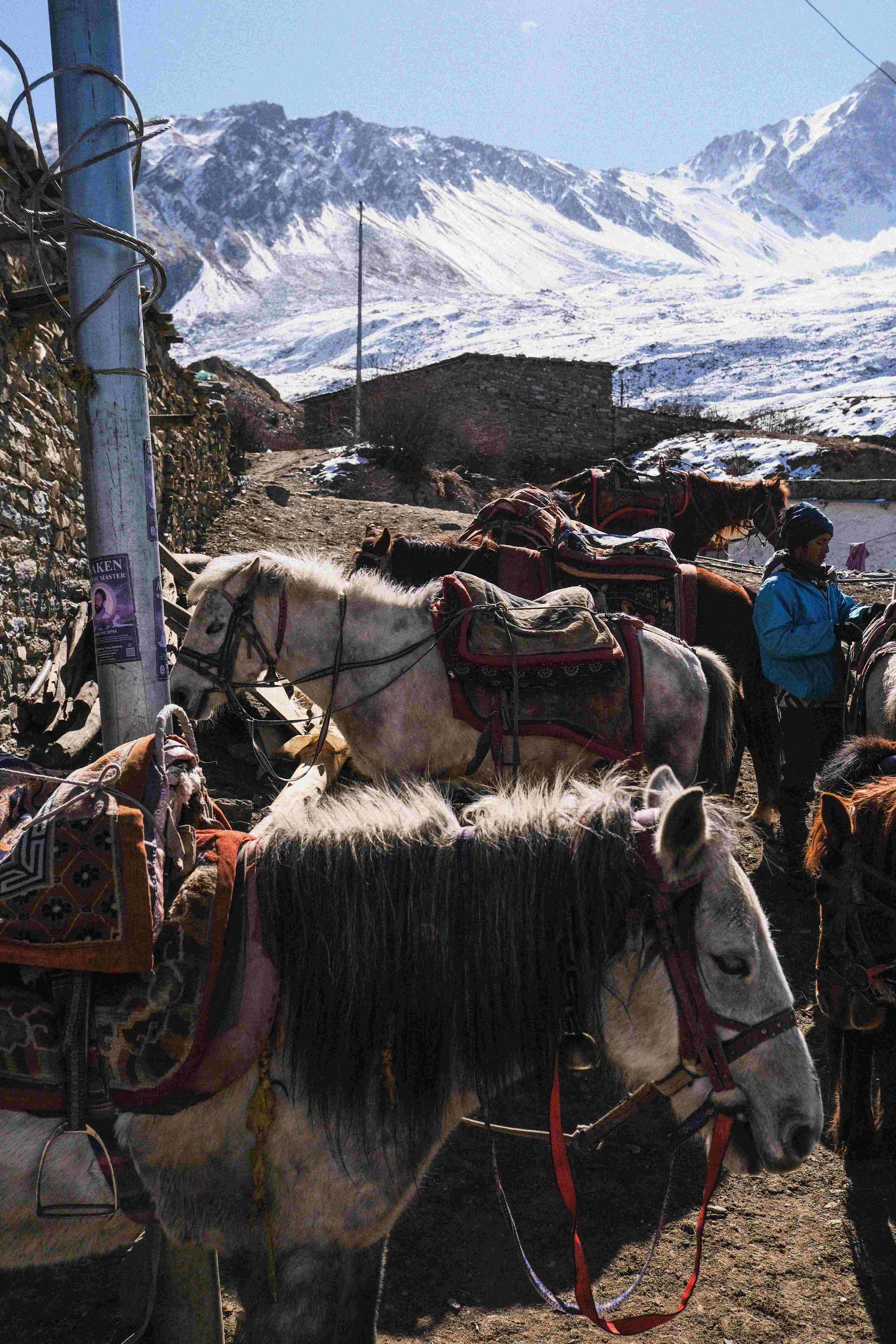
Horses have been part of everyday life in Mustang for generations. The traditional horses found in the region, often referred to as Mustang horses or Tibetan mountain ponies, are generally smaller than many Western riding breeds but are strong, agile, and remarkably sure-footed. Adapted to the Himalayas over generations, they are well suited to rocky trails, steep mountain passes, high altitudes, thin air, riverbeds, and changing mountain weather.
These are working horses, not animals raised exclusively for recreational riding. Throughout the year, they may transport food, agricultural supplies, firewood, construction materials, and other goods between villages, as well as carry people in areas where roads remain limited. Their lives are closely connected to the families and communities that own them, and they continue to form part of the traditional rural economy of Mustang.
For travellers, this also means that the horses may look and live differently from those found in riding schools, ranches, or professional equestrian centres. They are not typically maintained with the specialised grooming, stabling, or recreational care associated with leisure horses. Instead, they reflect a traditional Himalayan working lifestyle that has developed around the needs of mountain communities.
Responsible horse tourism in Mustang is closely connected to this existing relationship between horses, people, and livelihoods. Tourism provides horse-owning families and local horsemen with an additional source of income, creating economic value around animals that have traditionally supported their communities. This can, in turn, help make it possible for families to continue caring for their horses, maintaining them as healthy working animals, and preserving the knowledge and skills associated with handling them in difficult mountain terrain. Experienced local horsemen, who have often worked with these animals from an early age, remain an important part of this relationship.
At the same time, travellers should understand what they are signing up for. These are working mountain horses, and their appearance and condition may differ from what some visitors are accustomed to seeing. Those who are highly sensitive to the appearance or traditional working use of animals, or who expect horses maintained to recreational or competitive standards, may find that horseback travel in Mustang does not match their expectations.
For travellers who appreciate the realities of rural Himalayan life, however, riding through Mustang offers a distinctive way to experience a tradition that is still part of the region today. The journey supports local livelihoods while giving horses continued economic value within the communities that have depended on them for generations.
Horse Traditions and Festivals in Mustang
Horses also appear within Mustang's wider cultural traditions.
Across Himalayan communities, horses have historically been associated with movement, trade, status, strength, and the ability to cross difficult terrain.
Festivals and local celebrations can include horse riding, horse races, displays of horsemanship, music, dancing, and religious and social gatherings.
In Mustang, these traditions are especially significant because horses remain connected to the region's historical relationship with Tibet and its trading past.
One of the best-known examples is the Yartung Festival, traditionally celebrated in the Muktinath and surrounding areas.
The festival brings together communities through horse racing, riding, music, dancing, and religious and social celebrations.
Such events demonstrate that horses in Mustang are not simply animals used for transportation.
They are also part of the region's cultural memory.
Mustang's Festivals: Where Culture Remains Alive
The festivals of Mustang offer another window into the region's living traditions.
In Upper Mustang, festivals associated with Tibetan Buddhist communities bring together religious ceremonies, masked dances, music, prayers, and community gatherings.
The Tiji Festival in Lo Manthang is among the most famous.
But the importance of such festivals extends beyond their appeal to visitors.
They are occasions when communities come together, religious traditions are performed publicly, younger generations encounter inherited customs, and local identities are reaffirmed.
This distinction matters.
Mustang's culture should not be understood as something preserved only for tourists.
Much of it continues because communities themselves continue to value and practise it.
The Culture of Mustang Is Changing
It is tempting to describe Mustang as a place where nothing has changed for centuries.
That would be misleading.
Mustang is changing rapidly.
Young people are leaving remote villages in search of education, employment, healthcare, and opportunities elsewhere.
Modern roads have changed how goods move.
Solar power, telecommunications, vehicles, modern education, and new construction are becoming part of everyday life.
Tourism has created new employment opportunities but has also changed traditional economies.
Some old houses are being replaced.
Some traditional occupations are declining.
Some villages have fewer permanent residents than they once did.
And yet, alongside these changes, many communities continue to maintain monasteries, festivals, religious practices, traditional architecture, agricultural systems, and forms of social life that connect them to generations before them.
This is what makes travelling through Mustang particularly interesting.
You are not visiting a museum.
You are encountering a living culture negotiating its place in a changing world.
How Permits Work in Mustang
One of the most important practical differences between Lower and Upper Mustang is the permit system.
Lower Mustang
For travel through Lower Mustang, travellers generally need the Annapurna Conservation Area Permit (ACAP).
Depending on the route and current regulations, additional documentation such as TIMS or local permits may also apply.
Upper Mustang
Travelling beyond Kagbeni into the restricted Upper Mustang area requires a Restricted Area Permit (RAP).
Travellers also need the applicable conservation-area permit, including ACAP.
Because regulations and permit fees can change, travellers should always confirm the latest requirements before travelling.
The restricted permit system also means that Upper Mustang journeys are generally more expensive and require greater advance planning than journeys through Lower Mustang.
Lower Mustang or Upper Mustang: Which Should You Visit?
There is no single answer.
Choose Lower Mustang if you want:
Greater accessibility
Shorter itineraries
Easier integration with a wider Nepal journey
Muktinath and Jomsom
Marpha and the Kali Gandaki Valley
Villages such as Jhong and Lubra
Horseback riding without entering the restricted area
A combination of mountain scenery and diverse cultural traditions
Choose Upper Mustang if you want:
Lo Manthang
More pronounced Tibetan cultural influences
Ancient cave settlements
Dramatic desert-like landscapes
Traditional walled towns
Remote monasteries
A deeper journey into Mustang's historic northern culture
One of Nepal's most distinctive restricted-area experiences
And for travellers with enough time, the two regions can complement one another.
Lower Mustang provides the gateway and introduces the landscape gradually.
Upper Mustang takes you deeper into the Trans-Himalayan cultural world.
Exploring Mustang on Horseback
Horseback travel adds another dimension to the Mustang experience.
Instead of moving through the region primarily by road, you follow mountain trails and traditional routes that connect villages and valleys.
A multi-day horseback journey also changes the pace of travel.
You are not simply arriving at a viewpoint, taking photographs, and leaving.
You spend hours moving through the landscape.
You notice the changing colours of the cliffs.
You cross riverbeds.
You pass stone villages.
You hear prayer flags moving in the wind.
You meet farmers, horsemen, monks, and villagers.
And gradually, the landscape becomes less like a destination and more like a place you are travelling through.
A 13-Day Horseback Journey Through Lower Mustang
One way to experience this is through a 13-day horseback expedition through Lower Mustang and across Thorong La.
The journey begins in Kathmandu before travelling overland to Pokhara and then continuing north through the Kali Gandaki Valley towards Jomsom.
From Jomsom, the horseback journey begins.
The route passes through Jhong, Muktinath, Thorong Phedi, Thorong La, Lubra, and Marpha, combining dramatic Himalayan landscapes with some of Mustang's most interesting cultural sites.
An acclimatization day in Muktinath provides time to adjust before the journey reaches its highest point.
The expedition then crosses Thorong La at 5,416 metres, before descending towards Lower Mustang and eventually returning to Jomsom.
This route does not attempt to replicate an Upper Mustang expedition.
Instead, it explores a different side of Mustang — one where accessibility, cultural diversity, pilgrimage traditions, Bon heritage, historic villages, and horseback travel come together.
For travellers interested specifically in Upper Mustang, a separate restricted-area journey towards Lo Manthang offers a very different experience.
Why Horseback Travel Makes Sense in Mustang
There is something fitting about exploring Mustang on horseback.
The relationship between horse and landscape is not new here.
These animals have crossed the same mountains for generations.
They have carried goods through the Kali Gandaki corridor, connected isolated settlements, supported families, and helped people navigate a landscape where movement has never been easy.
Travelling on horseback therefore provides more than an alternative to trekking.
It creates a connection with the region's history.
You move at the pace of the mountains.
You travel along trails shaped by generations of movement.
And you become part of a form of travel that still has meaning for the communities you pass through.
Is Horseback Riding in Mustang Right for You?
A Mustang horseback expedition is not a conventional riding holiday.
The terrain is rugged.
The riding days can be long.
The altitude is significant.
Accommodation in remote areas is simple.
Weather can change quickly.
And the horses are working mountain animals rather than recreational horses maintained to the standards of an equestrian centre.
The experience is best suited to travellers who are comfortable with adventure, appreciate cultural immersion, and understand that authentic travel sometimes means accepting conditions different from those at home.
Previous horseback experience is important, particularly for a challenging multi-day expedition, but equally important is the ability to adapt to the realities of high-altitude travel.
When to Go Horseback Riding in Mustang
The main riding season generally runs from October through May, although conditions vary by month and altitude.
Autumn offers clearer skies and generally stable mountain conditions.
Winter brings colder temperatures, particularly at higher elevations, and snow can affect high passes.
Spring brings warmer conditions and changing landscapes, while the onset of the monsoon later in the year can make travel more difficult.
The best time ultimately depends on the route, altitude, weather conditions, and whether you plan to visit Lower or Upper Mustang.
Mustang Is More Than a Landscape
It is easy to fall in love with Mustang because of its mountains.
But the deeper story lies in the people who have learned to live among them.
It lies in the horsemen who understand the trails.
In the families who maintain orchards and fields in an environment where agriculture is difficult.
In monasteries that continue to serve their communities.
In festivals that bring villages together.
In the young people deciding whether to remain or leave.
In the older generations carrying knowledge that may otherwise disappear.
And in the horses that continue to connect people with a landscape that has always demanded resilience.
This is why travelling through Mustang — whether through Lower Mustang, Upper Mustang, or both — is about more than seeing the "Last Forbidden Kingdom."
It is about witnessing a region in transition while many of its oldest traditions remain alive.
And perhaps that is the most meaningful way to understand Mustang today: not as a place frozen in the past, but as a living Himalayan culture carrying its history into the future.
Could your next adventure be on horseback?
Frequently Asked Questions
1. Do I need a special permit to travel to Upper Mustang?
Yes. Upper Mustang is a restricted area, so international travelers require a Restricted Area Permit (RAP) in addition to the Annapurna Conservation Area Permit (ACAP) . Travel through the restricted area must be organized through a registered trekking agency with a licensed guide.